Food For Thought-How much do you spend a year on soft drinks?
posted on
June 16, 2026
Food Fix Uncensored: Chapter 1 The Hidden Price Tag of our Food
Last week, after I wrote about ultra-processed foods, someone commented that our food system is about feeding empty bellies.I’ve been thinking about that comment ever since.Nobody wants children to go hungry. I certainly don’t. Programs like SNAP exist because families sometimes hit hard times, and helping families put food on the table is something we should do.But the more I thought about that comment, the more I feel we have to focus on providing nutrition rather than simply filling bellies. The ultra-processed foods that have become a staple of our grocery stores and kitchens since the “Green Revolution” of the 1960s, while well-intentioned, have had dire consequences. Let’s look at corn today, which is the crop most subsidized by our tax dollars.In America, I believe we pay for corn four different times.
First, We Pay Through Subsidies
American taxpayers spend billions supporting commodity crop production. Corn is one of the largest beneficiaries. These subsidies help create an abundance of cheap corn that ends up in everything from livestock feed to corn starch, corn oil, and high-fructose corn syrup.Cheap corn helps create cheap calories.But that’s only the beginning.
Second, We Pay Through Environmental Costs
Modern corn production often relies heavily on synthetic fertilizers, herbicides, and large-scale monoculture farming.The costs don’t disappear when the crop is harvested. They contribute to water treatment, polluted waterways, soil degradation, biodiversity loss, and the long-term challenge of rebuilding healthy agricultural ecosystems.Again, taxpayers help carry those costs.
Third, We Pay Through SNAP
This is the part that troubles me most.Let me be clear: this is not about judging people who use SNAP. I believe it to be a critical part of our culture to help people feed themselves and their families when they need it. But the “Supplemental Nutrition Assistance Program” currently has almost no nutrition guidelines.This is about asking why some of the largest corporations in the world are allowed to profit from a program that was designed to improve nutrition.Take a look at the chart below, which shows the top SNAP purchases.
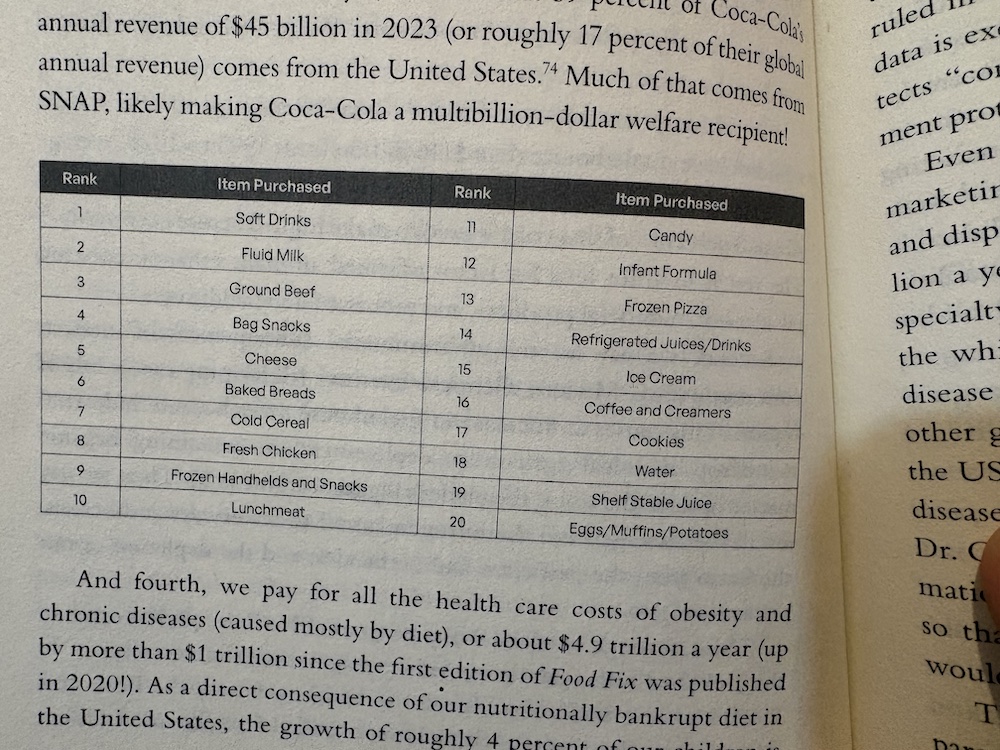
Notice anything missing?
Not a single fruit or vegetable appears in the top 20 purchases.
Soft drinks are the number one item purchased with SNAP benefits.Fruits and vegetables don’t even make the list.Think about that for a moment.
If SNAP stands for Supplemental Nutrition Assistance Program, why are taxpayer-funded nutrition dollars flowing so heavily toward products that provide little or no nutritional value?
A 12-ounce can of Coca-Cola contains 39 grams of sugar. The American Heart Association recommends limiting added sugar to 36 grams per day for men and 25 grams per day for women.
One can exceed the recommended daily limit!!
At the same time, research continues to connect sugar-sweetened beverages with obesity, Type 2 diabetes, heart disease, and other chronic illnesses. A recent global study estimated that sugary drinks contribute to 1.2 million new cases of cardiovascular disease and approximately 340,000 deaths each year worldwide.
Whenever this topic comes up, the conversation quickly shifts to personal freedom and choice.
But I think we’re asking the wrong question.
The question isn’t whether families deserve choices.The question is why multinational beverage companies have successfully turned a nutrition program into a revenue stream. We already place limits on SNAP purchases. Taxpayer dollars cannot be used for alcohol or tobacco. Society has already decided that public assistance programs should not subsidize products known to cause harm.
Why is soda different?
The campaigns defending these purchases are often supported by the very companies that stand to lose billions if those sales disappear.
That’s not a coincidence.
Change is on the horizon in Colorado. Colorado received federal approval to restrict SNAP purchases of soda and other sweetened beverages, but implementation has faced delays and legal challenges. As of now, that change would go into place in October, but it has already been delayed twice.
Fourth, We Pay Through Healthcare Costs
Finally, we pay for the consequences.We subsidize the production of corn.We absorb many of the environmental costs associated with growing it.We use taxpayer dollars to purchase products made from it.Then we spend billions treating obesity, diabetes, heart disease, and other chronic diseases that follow.According to estimates cited in Food Fix Uncensored, chronic disease is expected to cost the American economy $129 trillion over the next 35 years through healthcare expenses, lost productivity, and disability.At some point, we have to ask whether our food policies are solving problems or creating them.
A Better Question
This isn’t an argument against helping families.
It’s an argument for helping them better.
We don’t have to choose between feeding people and improving nutrition.
We can do both.
The question isn’t whether Americans deserve help putting food on the table.
The question is whether taxpayer dollars should finance the profits of multinational beverage companies while simultaneously funding the healthcare costs that result.
Every year, an estimated $12 billion in SNAP benefits is spent on Coca-Cola products alone.
That comes out to about $35 a year pre-American, so even if you yourself don’t buy sugar-sweetened drinks, your tax dollars do!
Twelve billion dollars.That’s enough money to buy an incredible amount of real food. Especially if farm subsidies were shifted away from commodity crops like corn, soy, wheat, and rice and into fruit, vegetables, and quality proteins. How many eggs could that purchase? How many pounds of carrots? How many bananas, apples, or sweet potatoes? How many families could be provided with nutrient-dense foods that support health instead of contributing to chronic disease?
If SNAP stands for Supplemental Nutrition Assistance Program, let’s put nutrition back at the center of it.
What are your thoughts?
Aila
Shop the Farm
P.S. More information about Food Fix Uncensored and any of the stats or studies I used can be found on the book's website